
Feature on Idaho State football’s improvement

The Idaho State football team had its first winning season in over a decade last year. Head coach Mike Kramer told me a big reason for the turnaround was due to an increased focus on academics. The results were tangible (e.g. a recovery of lost scholarships) and immeasurable (e.g. smart players –> smart plays –> wins), and I found that improved APR correlated with victories on the field.

Here’s the link to my story, with an excerpt below:

Idaho State went 6-39 (4-28 in conference) from 2007 to 2010, Zamberlin’s four years as head coach. The ineptitude reached its peak in 2008, when the Bengals needed an overtime win over Sacramento State in the season’s final game to avoid finishing 0-12. That season, Idaho State finished last in the FCS in total defense (480 yards per game) and second to last in scoring defense (41 points per game).

The Bengals lacked depth during Zamberlin’s tenure, due in part to a poor Academic Progress Rate (APR).

In 2010-11, Idaho State’s four-year APR was 881, and its average APR over the previous two seasons was below 900. Beginning in 2012-13, NCAA teams were required to have a minimum four-year APR of 900, or a two-year average of 930. If teams don’t meet those requirements, they’re penalized.

The NCAA took away about three and a half of Idaho State’s scholarships per year until the Bengals reached the minimum APR threshold, according to athletic director Jeff Tingey.

“A senior would graduate and we wouldn’t fill anyone in,” Tingey said in a phone interview.

Tingey, Kramer and company focused on improving the football team’s APR, and avoiding penalties wasn’t the only reason. Idaho State believed the on-field product would improve if intelligent players inhabited its roster.

Improved academics would, of course, give Idaho State the scholarships it lost, and a team full of academically eligible players would increase consistency. But Kramer believes intelligence is as important to on-field performance as physical attributes.

When Kramer recruits quarterbacks, he immediately looks at their academic transcripts. If their grade point average is below 3.8, he often passes.

“If your grade point isn’t exceptional and your brain doesn’t work fast enough then you can’t play the (quarterback) position,” Kramer said. “It’s not a javelin throwing contest.”
Q&A with new Idaho State quarterback

Junior college quarterback Michael Sanders announced on Twitter Feb. 12 that he would commit to Idaho State. That day, I followed him on Twitter, and he followed back. I sent him a direct message, asking if I could interview him. He said yes, and we talked the next morning.

My Q&A, published in the Post Register on Feb. 14, was exclusive. Here’s the link.

Feature on wrestler with a suffering father

This week, I wrote a feature on Skyline High School freshman wrestler Kade Lincoln. He has dominated the 98-pound weight class so far in his high school career and looks like a star in the making.

The fact that Lincoln has become so successful while his father has battled esophageal cancer and its aftermath makes his story even more incredible. My interviews with Lincoln and his father were devastating, but they seem to be handling it as well as anyone in their situation could.

Here’s the link. Here’s the first section:

Kade Lincoln tries to clear his mind when he steps on the wrestling mat. Background noise is muted. Off-mat distractions evaporate.

Sometimes, life muddles things for the Skyline High School freshman. When it doesn’t, he becomes nearly unbeatable.

Kade has gone 22-0 in his young Skyline career, which includes a title in the 98-pound weight class at this month’s prestigious Rollie Lane Invitational. He’s become a star wrestler while his father, Mark, has battled the aftermath of esophageal cancer.

“Wrestling really helped me go through that phase,” Kade said. “I could stay focused with wrestling and not just worry about my dad.”

Soccer coach returns from “toughest week of my life”

If I’m not covering a game for the Post Register, I’m in the office taking calls from area coaches (my work week spans from Tuesday-Saturday). Ideally, every coach whose team plays that day calls in the score, provides stats and gives us a couple of quotes. Whoever takes the call then writes up a 100ish-word recap.

These recaps, as you can imagine, are usually bare-bones and formulaic. But one I wrote a few of months ago served as a mini-feature.

I covered a Rigby High School boys soccer game in late September and found out Rigby’s coach, Bart Mower, was in Salt Lake City. He traveled to a hospital there with his wife, who was getting a brain tumor surgically removed.

Mower called in his team’s score the following week. It was his first game since his wife’s surgery. After getting the details of the game, I asked Mower about his wife. As you’ll see in the story below, he was open with me. Here’s the link to that recap.

A fews days later, I was in the office and took another call from Mower. He gave me the usual details from the game and talked about his team’s performance. But at the end of the call, he thanked me for writing the recap about his wife. He said he received a lot of feedback and support.

Out of all the stories I’ve written for the Register so far, this stuck with me the most (and I’ve written other stories about athletes or coaches who have gone through life hardships). There are a couple of reasons for that: 1) Hearing about the impact of your story from a subject firsthand — especially an emotional story like this — always makes a mark; 2) the impact came from a short recap in a soccer roundup. Ninety-nine percent of the time, those don’t elicit emotional responses. I would’ve loved to do a bigger feature on Mower, and even though I was busy at the time, I probably could’ve gotten something bigger published. But part of me thought, maybe this short recap was more than enough. The fact that a story so basic could create such an impact, however big it truly was, always reminds me about the value of this profession.

At Pocatello, the Rigby High School boys soccer team prevailed 3-0 in coach Bart Mower’s first game since his wife’s surgery last week.

Mower accompanied his wife, Chantel, to Salt Lake City during the middle of last week while she underwent surgery for a brain tumor. The surgery was successful, but she has felt nauseous in the days since and is deaf in her left ear because of the surgery.

“This has been the toughest week of my life,” Mower said.

Mower didn’t know if his team played extra hard for him Tuesday, but he believes his return played a factor. His players certainly made him proud.

“The best I’ve seen them play all season,” Mower said. “It was the way soccer is meant to be.”

Kyle Bichsel and Carlos Murillo each scored a goal in the first half, and Dexter Johnston completed the scoring midway through the second half. On Murillo’s goal, Mower said the ball went from goalkeeper to Murillo without one Pocatello player touching the ball.

Rigby (3-8-2, 2-3-1) hosts Preston Thursday.

Keegan Hansen coverage

In December, the Post Register’s sports desk discovered that senior basketball player Keegan Hansen was attempting to become eligible to play for Bonneville High School after transferring from Capital the previous summer. This was big news for us, not just because a great player was attempting to play in our area, but also because he played for the Bees during his freshman and sophomore seasons.

The first thing I wrote was a short post about Hansen’s attempt to play for Bonneville. That post can be found here.

As I write, the Idaho High School Activities Association would determine Hansen’s eligibility four days after my story was published I checked in with the IHSAA on that Tuesday and was informed he was declared eligible.

I broke the news on Twitter (scroll down to Dec. 9 on that linked page).

I then wrote a story on his eligibility for the next day’s Post Register, which can be found here.

But Hansen’s story didn’t end there. Through interviews with Bonneville’s head coach and discussions with my editor, I heard that one of Hansen’s main decisions to transfer to Capital last year was to try to reconnect with his father, who had been absent for most of Hansen’s life.

So, I interviewed Hansen a couple of days after he was declared eligible, and he told me his story of trying — and ultimately failing — to develop a relationship with his elusive father (Hansen declined to give me contact information for his father or mother).

That Sunday, the Post Register published my feature on Hansen’s one-year quest to reconnect with his father. Here’s the link to that story. Below are the first eight paragraphs.

Keegan Hansen was riding in his friend’s car when his cell phone started ringing.

The call was from an unknown number. A curious Hansen answered.

It was his father, La’Mar Davis.

Hansen hadn’t seen Davis since he was a kid, let alone talked to him. Now, in his sophomore year at Bonneville High School, Hansen was catching up with the male figure he craved for the past decade.

Near the end of the hour-long phone call, Davis asked his son a question: Did Hansen want to transfer schools and live with him?

After some deliberation, Hansen said yes.

This marked the beginning of a two-year emotional maze for Hansen. He lived in the Boise area for a year to be closer to Davis, 49, but their relationship fizzled. That would derail many student-athletes. Hansen, now a senior at Bonneville, keeps on moving.

“I grew a lot from that experience moving to Boise,” Hansen said. “I felt that I could take that, grow with it and become a new person here where I started.”

Feature on former Blackfoot High School athlete involved in nationally known hazing incident

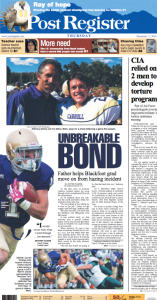
Anthony-Clarke-PR-cover-12.11.14Anthony Clarke just finished up his successful four-year career as a star wide receiver and special teamer for Carroll College in Helena, Mont.

But in Eastern Idaho, he is known as one of the five alleged perpetrators in a hazing incident at Blackfoot High School that made national news (here’s the first link that pops up when you Google “Anthony Clarke Blackfoot”).

The allegations halted Clarke’s blossoming walk-on football career at Boise State and split the Blackfoot community. But they only made his relationship with his father, Mark, stronger.

Here’s my story on Clarke, which made A1 of the Dec. 11 issue of the Post Register.

Here’s the first section of the story:

On the first carry of Anthony Clarke’s football career, he burst through a hole and galloped 60 yards for a touchdown.

As he sprinted down the sideline, his coach and father, Mark, ran stride-for-stride with him.

‘He was yelling at me, telling me to turn on the jets, I better not get caught, stuff like that,’ Anthony said.

The year was 2002. The team was the Blackfoot Jets fifth-grade Grid Kid squad.

It was evident early on that Anthony was a special football player. And it was obvious that Mark would do whatever he could to help his son succeed.

When Anthony, 23, was a boy, Mark sometimes worked from 5 a.m. to 7 p.m., but that didn’t deter him from playing sports with his children when he got home. If Anthony wanted to work on his passing skills, Mark would be his wide receiver, and vice versa.

‘The fire that keeps me going is the fire that fuels him, too,’ Anthony said.

As a Blackfoot High School senior, Anthony gained a combined 3,169 all-purpose yards and scored 24 touchdowns to lead the Broncos to their second 4A state title in school history. The Post Register named him its 2009 Football Player of the Year.

He chose to pursue college football at Boise State University as a walk-on. Even so, he quickly made an impression, earning the Broncos’ offensive scout team player of the year award. Anthony seemed destined for an increased role at BSU, one of the nation’s top programs, during his redshirt freshman season.

But his football story doesn’t end on the blue turf of BSU’s Albertsons Stadium. His story is part Greek tragedy and part a tale of redemption. It’s also the story of a father and a son and their unbreakable bond.

Skyline-Hillcrest High School football gamer

You may be wondering why I’m posting a game story that is nearly two months old, but I can explain.

I recently attended an Athletic Advisory Committee meeting for school District 91 in Idaho Falls. The district includes Skyline and Idaho Falls High School.

One of the meeting’s topics was sportsmanship. A Committee member, Mike Morrison, opened the sportsmanship discussion by mentioning a gamer he read in the Post Register. The story, which recapped a Skyline-Hillcrest football game, mentioned two Skyline fans yelling at each other in the stands. Morrison said he was appalled when he read about this fan behavior.

As you can infer, the story Morrison mentioned was mine. The game was one of the more intense sporting events I’ve covered in Idaho Falls, as you can see here and below.

It was exciting to hear my story mentioned (even though Morrison didn’t know it was mine until I told him) for several reasons: A) It was a rare instance of reader feedback, B) it was viewed as a fair article and C) it helped spark a larger discussion of sportsmanship among fans at games. My goal for every story is to be fair and provide information to the public that people might not be aware of if not for my story. I’m glad my story had that effect.

Here’s the first section of my gamer:

The hostility was tangible.

The Skyline High School football team was on the wrong end of two pass interference penalties, and the Grizzlies’ heated disagreement resulted in extra flags. At one point, two Skyline fans got into a shouting match. At another point, two Skyline defenders got into a shoving match.

Skyline was tied with Hillcrest 14-14 when the anger boiled over. Four plays after the two Grizzly defenders engaged in a minor civil war, Hillcrest scored the game-winning touchdown. The Knights (5-1, 2-0) were far from their best, but they looked tranquil compared to the Grizzlies (3-3, 1-1) on Friday night at Ravsten Stadium. The intense 21-14 win keeps Hillcrest tied with Highland for the 5A District 5-6 lead.

‘Calls went against us in the first half and they went against (Skyline) in the second half,’ Hillcrest coach Jeff Marshall said. “I think that pretty much balanced out, but I feel fortunate about how things went in the second half.’

Profile of Rigby HS football coach

Before the Rigby High School football team played its state semifinal game on Nov. 15, 2014, I wrote a profile on the Trojans’ head coach, Randy Waite.

Here is the link to the story, and below is the first section:

The Rigby High School football team gathered in the film room Monday, excited to watch tape of its comeback victory over Lakeland in the 4A state quarterfinals.

Head coach Randy Waite came in, turned on the tape and showed one play: Solo Taylor’s fourth-quarter interception that sealed the 29-28 victory.

‘That’s over,’ Waite told his players. ‘Bishop Kelly now.’

Rigby’s matchup tonight at Bishop Kelly marks the Trojans’ first state semifinal appearance since 1999. In fact, 1999 was Rigby’s last winning season until last year: Waite’s first as head coach.

Rigby’s sudden improvement and Waite’s arrival are not coincidental, his players and assistant coaches say. Waite has transformed the football program from a doormat to a perennial playoff contender.

‘He’s one of the smartest football minds I’ve ever been around,’ senior running back Tyrel Phillips said.

Idaho state volleyball championship coverage

On Nov. 1, I covered the final matches in Idaho’s 5A high school state volleyball tournament. My main focus was on the lone local team still alive in the tournament: Idaho Falls High School.

The Tigers won both of their matches. The second match was for the state title. Below are the opening paragraphs of my state final day recap for Idaho Falls. Here is the full story.

The Idaho Falls High School volleyball team prepared for its final serve of the season. Its bench players stood up, clenching each other’s hands. Those hands practically lost circulation as Coeur d’Alene attempted its return.

The return was powerful. But long.

The Tigers screamed in ecstasy as they piled onto the court. They were state champions.

‘I don’t even know what was going through my head,’ said senior Bailee Mills (8 total aces, 12 kills, 26 digs). ‘It was overwhelming.’

Idaho Falls needed to beat Coeur d’Alene in two matches Saturday at Skyline High School to receive the 5A state crown. The Tigers (33-9) dropped one set all day, a tight 25-22 win for the Vikings (21-5) in the second set of the title match. The 25-15, 26-24, 22-25, 25-15 win secured Idaho Falls’ fifth state championship in program history (and under head coach Wendy Johnson) and its first since 2011.

“(My players) are no drama, they’re hard workers, they’ve done everything I’ve asked,” Johnson said. “I’m just so ecstatic for them.”

Emotion Bowl coverage

For those unfamiliar, the Emotion Bowl is the biggest high school football rivalry in Idaho Falls, and one of the biggest in the state. On Oct. 25, 2014, Skyline and Idaho Falls HS battled in this rivalry game for the 50th time.

I wrote two features for the Post Register leading up to the game and wrote the game story. Below are the links to each piece.

50 years of the Emotion Bowl: Barnes, Hurley look back on the game that started it all

Compass Academy Emotion Bowl players true to their school(s)

Skyline secures spot in KC playoff with 41-21 Emotion Bowl win